Remember everyone you meet.
Brains drop names first and keep everything around them: the rooftop, the Tuesday night, the face across the table. Synapse saves that context — where, when, and the photos you took — so you can find anyone later, and reach out while it still counts.
No account · On-device first · Export or delete anytime
In memory experiments, people remember the baker and forget Mr. Baker — the identical word. A name is a label with nothing attached. Brains were never built for them.
The Baker/baker paradox · McWeeny, Young, Hay & Ellis, British Journal of Psychology, 1987
Five scraps of context become one memory.
A pin, a timestamp, a burst of photos, a card, a handle. On their own they’re noise. Fused, they’re the night you met two people worth keeping.
From a blur of faces to a memory you can search.
Anchor the moment
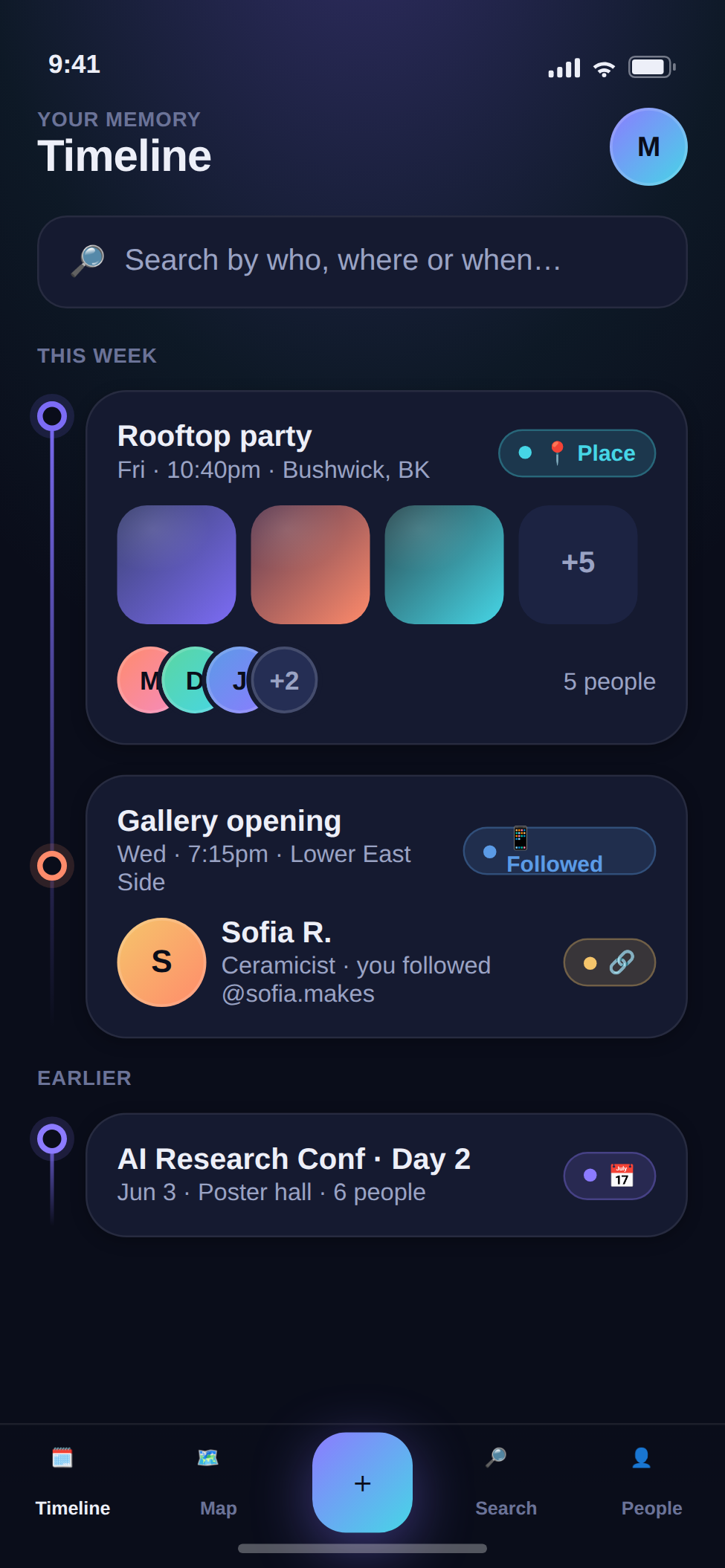
One tap saves where you are, the time, and the photos from that window. Cards, calendar events, and shared profiles drop into the same moment.
Signals become people
A saved contact, a followed account, a face in a photo: when they look like the same person, Synapse suggests the merge, shows how sure it is, and waits for you.
Search by where & when
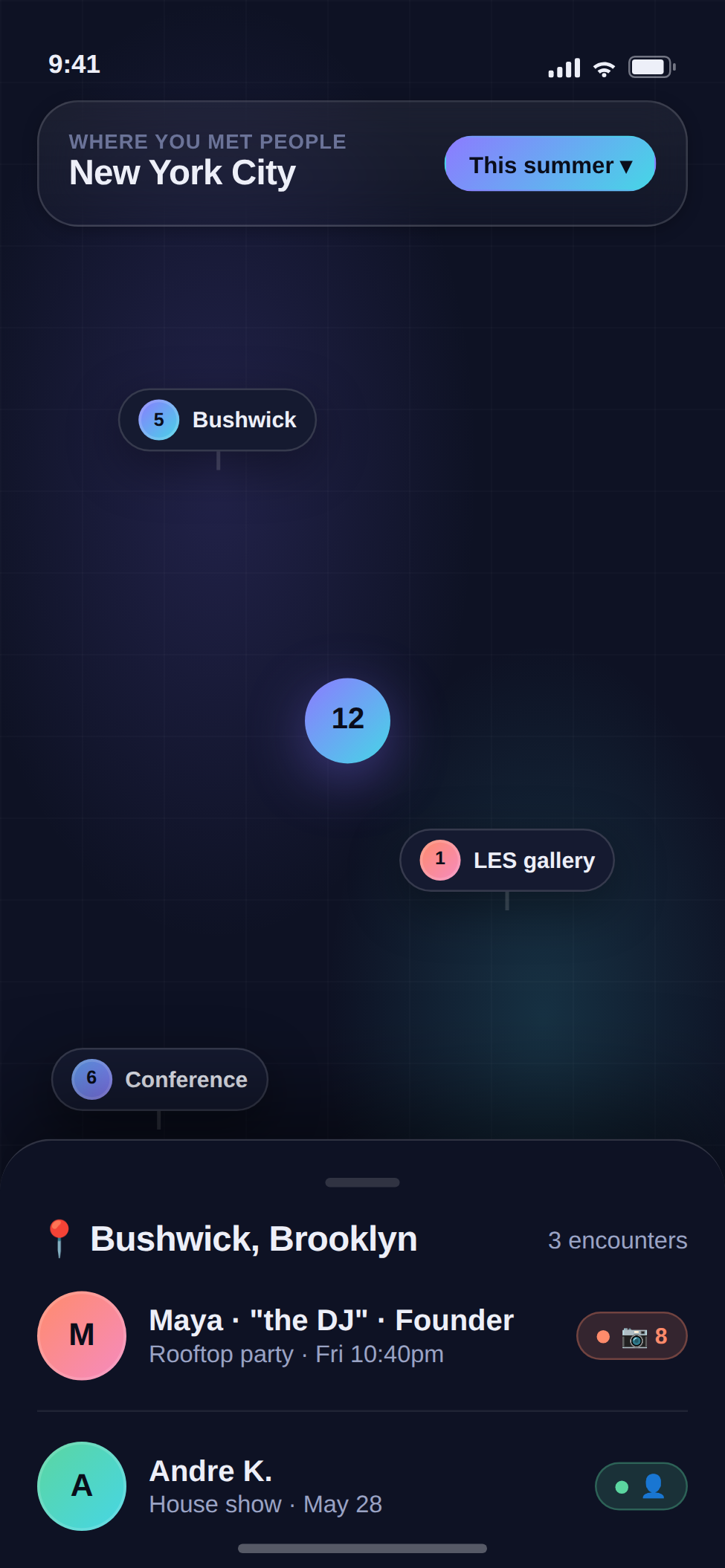
Type “the woman from the rooftop in June.” Or scroll the timeline, or open the map. Every match explains why it’s there.
Follow up in time
An inbox lines up due reminders, good reasons to say hi, and people drifting out of touch. Reaching out is one tap.
Built for people who meet a lot of people.
The app has three jobs: capture the moment, recall the person, reconnect before it goes cold. Everything here does one of them.
Get it down before it fades.
Every way of meeting someone lands in the same place: an encounter, with a time, a place, and the people in it.
The forgetting curve is steepest in the first hours after a moment. Capture wins by taking seconds, not willpower.
Ebbinghaus, 1885 · replicated in PLOS ONE, 2015One tap, whole moment
Tap once and Synapse pins the place, the time, and any photos taken around then. Name people on the spot, later, or never.
Scan a business card
Point the camera at a card and your phone reads it: name, title, company, email, the LinkedIn URL printed in the corner. Nothing is saved until you’ve looked it over.
From a calendar event
Pick a meeting off your calendar and its attendees become people on that encounter, with the time and place already filled in.
Share a profile in
When someone sends their LinkedIn or Instagram, share it into Synapse right from that app, or paste the link during capture. The URL alone gives Synapse the handle and a fair guess at the name, so it works offline too.
Find people the way memory works.
Not by name. By the rooftop, by June, by the friend they came with.
Divers who learned words underwater recalled them best underwater. Memory runs on context — so does this search.
Godden & Baddeley, British Journal of Psychology, 1975Search in your own words
Type “the founder from the rooftop in June” and get her. Search understands time, place, and detail, and explains why each result matched. It all runs on your phone.
Map & timeline
Scroll back through your weeks, or open the map and see where you’ve met everyone. Some people you’ll only find by the neighborhood.
“Probably the same person”
When two entries look like the same person, Synapse says so and shows how sure it is. Nothing merges until you agree.
Faces grouped on your phone
Photos from a moment get clustered by face so you can put names to them. Detection runs entirely on-device; your photos never leave it.
Reach out while they still remember you.
Knowing who someone was is half the job. The other half is sending the message while it still feels natural.
In studies of nearly 6,000 people, a simple check-in was appreciated far more than the sender expected — most when it was least expected.
Liu, Rim, Min & Min, J. Personality & Social Psychology, 2022The Reconnect inbox
One queue for everything that deserves a follow-up: reminders that came due, people worth a nudge, and people drifting out of touch. One row per person, most urgent first.
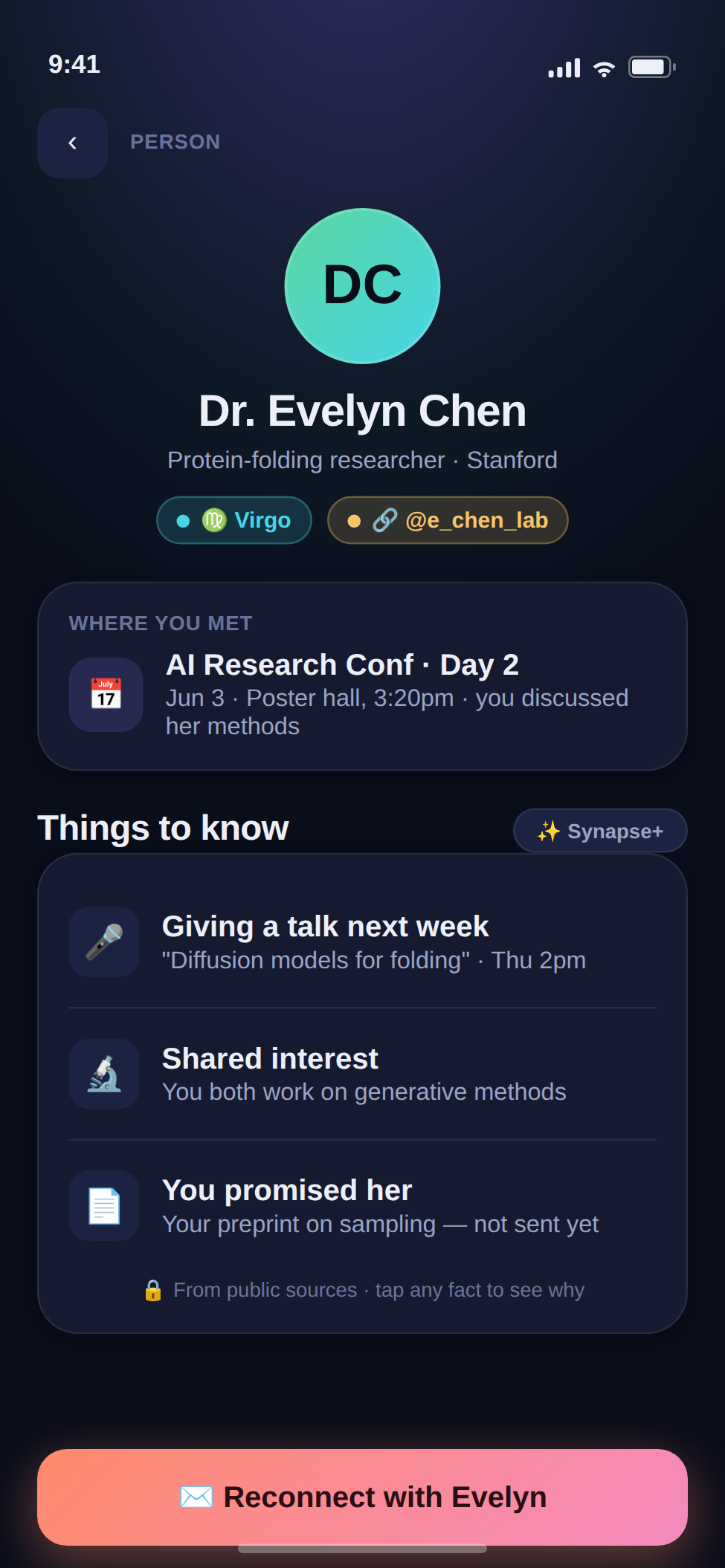
Things to know
A reason to reach out, right on the profile: an upcoming talk, a shared interest. Facts from your own data are free; Synapse+ adds web lookups with sources, which you approve fact by fact.
One tap to reach out
Message, email, or Instagram DM straight from a profile. If now isn’t the moment, set a reminder — it resurfaces at the top of the inbox when it’s due.
The Sunday recap
Sunday evening, a short digest: the new faces from your week, the places it happened, and who deserves a message. Put together on your phone, sent as one quiet notification.
Anyone you were glad you met.
The founder from the rooftop who’s building something in your space.
The couple from the hostel in Lisbon who said come stay, seriously.
Your cousin’s friend who knows everything about immigration law.
The drummer from the open mic who seemed to know the whole city.
Half the wedding table you swore you’d visit.
The regular at your coffee shop whose name you’ve been faking for a year.
The core is free, and stays free.
Capture, search, the map, the inbox, the recap: that’s the product, and none of it sits behind a paywall. Synapse+ pays for the parts that cost real money to run.
Free
The whole loop, no account required.
- One-tap capture, card scanning, calendar & profile import
- Plain-words search, map, and timeline
- Same-person suggestions and on-device face grouping
- Reconnect inbox, reminders, and the weekly recap
- Things to know from your own data
- Export and delete everything, in Settings
Synapse+
The expensive parts.
- Sourced “things to know” from the web: real lookups with citations, opt-in, and you approve every fact before it’s saved
- More on the way: longer history, deeper search, sync
- Billed through the App Store or Google Play; cancel there anytime
Privacy is the product.
Synapse asks for deep permissions, so it has to earn them. Everything is processed on your phone first, nothing feeds ads or trackers, and you can export or wipe it all in Settings.
After 85 years, Harvard’s longest-running study keeps landing on the same answer: good relationships — more than money, fame, or genes — are what make lives go well.
Harvard Study of Adult Development, 1938–presentAnd in an experiment spanning 20 million people, it was the acquaintances — not the close friends — who most often led to the next job.
Rajkumar et al., Science, 2022You’ll meet someone worth remembering this week.
Synapse is in early testing on iOS (TestFlight) and Android (Play internal). Want in?